Skip to content

The Idea of the Week
Thinking about what happened is not necessarily processing. Sometimes, thinking about the memory becomes rumination. Rumination (7-minute article) is repeatedly thinking about what happened for an extended period of time. Often, rumination makes us feel worse.
On the other hand, emotional processing is thinking about the event and generating new ways of thinking, new behaviors, or new possibilities. The article above from Verywell Mind outlines the difference between rumination and emotional processing. It also offers helpful signs to watch for and practical tools if you find yourself stuck in a loop.
When we do not process, we can get stuck in patterns. An anxious cycle of what-ifs and should-haves.
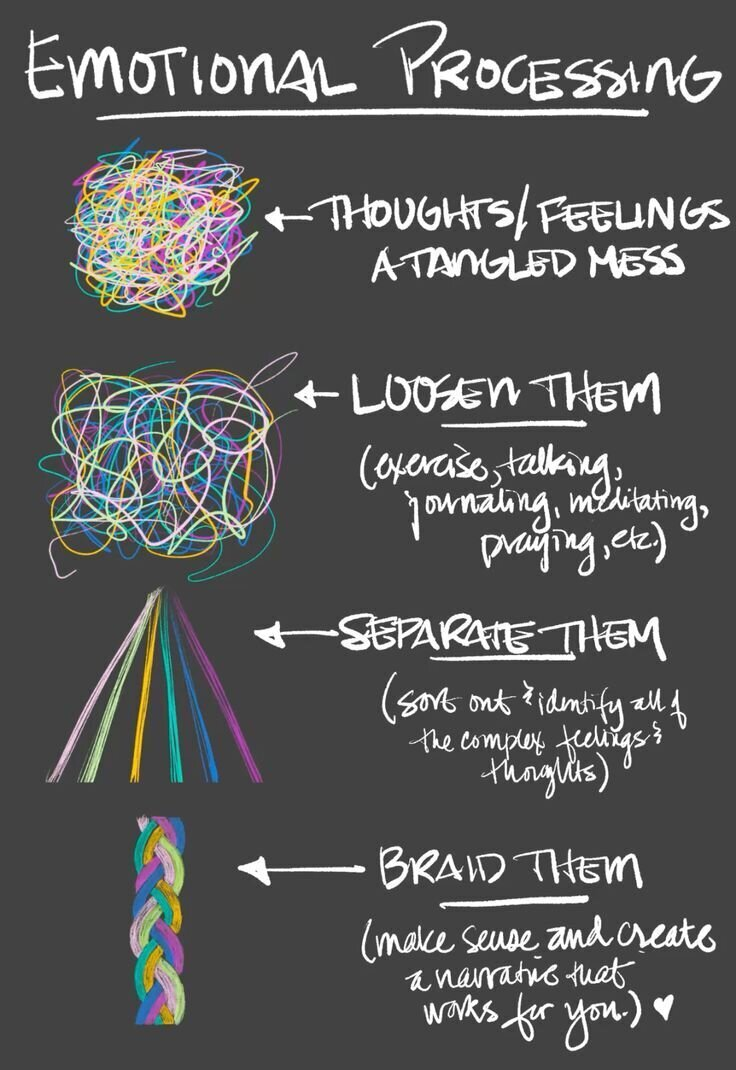
When we give ourselves space to process what happened, we acknowledge, understand, honor, and integrate the emotional experience into our life story. We make meaning from the experience that promotes adaptive functioning.
Think about it like a sea. When we do not process, we are tossed on a stormy sea of emotions. When we do process, we learn to navigate the turbulent waters and emerge from the storm with insight about our experience.
The Practice of the Week
So, how do we actually process an experience, especially when it feels tangled or raw? Let’s explore a few practical ways to begin.
Explain and express
Grab a journal. Sometimes the physical act of writing is helpful to work through the emotions. However, other journaling methods can work, too, such as typing or speaking aloud with a friend or into a voice note.
The idea here is simple and short:
Explain what happened.
Express how it made you feel.
This 8-minute article from Psychology Today offers 2 additional writing practices to support this process. Here’s a breakdown of each.
Five-Day Deep Dive
Write about one painful experience for 15 minutes a day for 5 days. Use pen and paper if you can.
What to do each day:
- Every Day:
- Explain the event: What happened?
- Express your emotions: How did it make you feel?
- Describe the scene like you’re a movie director: Who was involved? What were the roles, actions, objects, setting, and intentions?
- Reflect on your conclusions: What beliefs did you form about yourself, others, or life? How are you making sense of the event?
- Day 5:
After writing for the fifth day, gather the pages and burn or shred them. This is your symbolic release—letting go of what no longer serves you.
Changing Perspectives
This approach helps shift your relationship to a painful memory by writing from different points of view.
Write for 15 minutes a day using the following structure:
- Day 1: Write the entire story using first-person.
First-person: “I lost the keys.”
Include your emotions, actions, thoughts, and what you started to believe about yourself. - Day 2: Rewrite the story using second-person.
Second-person: “You lost the keys.”
Imagine someone is talking to you, describing the scene. - Day 3: Rewrite the story using third-person.
Third-person: “They lost the keys.”
Write as if a stranger is narrating the story with you as one of the characters. - Day 4: Reflect on life lessons.
Reflect on lessons learned and what you’ve overcome. What new perspectives have emerged? - Day 5: Close the loop with reflection.
What’s shifted? What strength have you reclaimed? When you’re ready, gather and burn or shred the pages.
There is no “right” way to process, and this is not a one-size-fits-all approach. Processing will look different for everyone. Sometimes we do need days or even months between us and the event before we can bring it up for processing.
News of the Week
Sign up for our newsletter to be the first to know about upcoming events and special deals!
The Thought of the Week
Wishing you a peaceful week!